- Solar Powered Drinking Water System
- WaterHome — Solar-Powered Mobile Beverage Station
- Solar Powered Sewage Treatment Plant
- Solar Powered Pond Aerator
- Solar Powered Water Pump
- Fiberglass Lift Station
- Solar Powered Fish Aerator
- Submersible Jet Aerator
- Solar Powered Irrigation System
- Solar Microgrid System

Micro Nano Solar Powered Lake Aerator from China | Low Noise & Low Disturbance Suppliers and Factory Solutions
Payment & Shipping Terms
Introduction
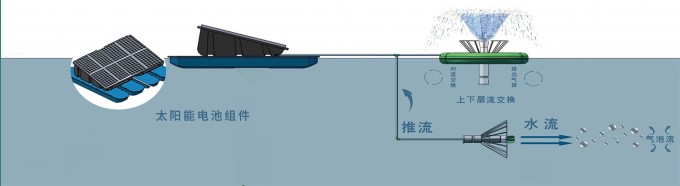
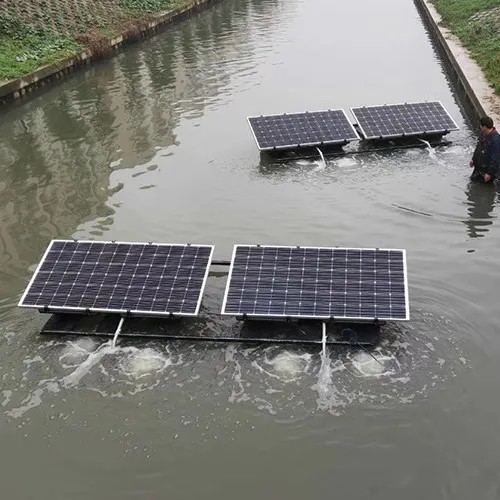
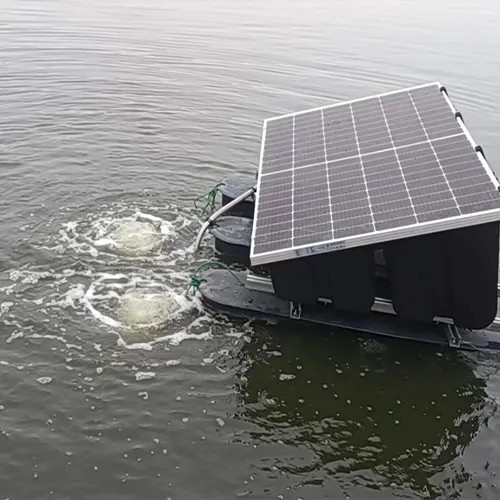
The solar-powered micro-nano aerator is an environmental protection device that uses solar energy as its power source and generates micro-nano bubbles to oxygenate water bodies and improve water quality. The core of it is to convert solar energy into electricity to drive the aeration system, which is suitable for ecological restoration and water quality maintenance of various water bodies such as lakes, rivers and ponds. It is especially suitable for scenarios where power supply is inconvenient or low-carbon and energy-saving are required.
Characteristics
Powered by solar photovoltaic panels, it does not need to be connected to the power grid, reducing reliance on traditional energy sources, with low operating costs, which is in line with the concept of sustainable development.
It is adapted to different lighting conditions and equipped with an energy storage battery, allowing for continuous operation at night or on rainy days.
It generates micro-nano bubbles with diameters ranging from 0.1 to 10 micrometers, featuring a large specific surface area and low buoyancy. These bubbles can stay in water for several hours, and the dissolved oxygen efficiency is 3 to 5 times that of traditional aeration methods.
Bubbles carry electric charges and can adsorb pollutants in water bodies (such as organic matter and heavy metal ions), promote microbial decomposition, reduce indicators such as ammonia nitrogen and COD, and enhance the self-purification capacity of water bodies.
It adopts a DC brushless motor and a silent design, with the operating noise below 50 decibels, avoiding interference to the surrounding environment (such as residential areas and aquatic life).
Micro-nano bubbles diffuse uniformly, cause little disturbance to the water flow, and do not disrupt the original ecological balance of the water body.
Integrated with an intelligent control system, it can automatically adjust the aeration frequency according to the light intensity and dissolved oxygen concentration, achieving energy-saving operation.
Supports remote monitoring (such as mobile phone apps, Internet of Things platforms), allowing real-time viewing of device status and water quality data, with low maintenance costs.
Modular design, no need for complex construction, can be fixed on the water surface through a float or bracket, suitable for water bodies of different depths (0.5 to 5 meters).
It has strong corrosion resistance. The main materials are stainless steel, engineering plastics, etc., and it can adapt to various water quality environments such as fresh water and slightly brackish water.
Working principle
- Solar photovoltaic panels: Absorb sunlight and convert it into electrical energy, which is stored in batteries or directly drives motors.
- Control system: Regulate the distribution of electrical energy and control the start, stop and operating power of the aerator according to the set parameters (such as dissolved oxygen threshold).
Gas-liquid mixing technology: The motor drives the impeller or pump body to shear air and water at high speed in a specially designed mixing chamber, forming micron-sized bubbles. Some bubbles are further broken through nanoscale microporous aeration heads (with pore diameters ≤10 microns) to generate nanoscale bubbles.
Bubble characteristics and functions:
- High dissolved oxygen: Micro-nano bubbles slowly release oxygen during their ascent, significantly increasing the dissolved oxygen content in water bodies (DO can reach 8 to 10 mg/L).
- Interfacial charge effect: The surface of bubbles carries a negative charge, which electrostatically adsorbs pollutants (such as positively charged suspended particles), accelerating flocculation and sedimentation.
- Free radical oxidation: When bubbles burst, hydroxyl radicals (· OH) are produced, which degrade insoluble organic matter and enhance the water purification effect.
When the aerator is in operation, micro-nano bubbles drive the flow between the upper and lower layers of the water body, breaking the stratification of the water body and promoting the uniform distribution of dissolved oxygen, nutrients and microorganisms.
Long-term use can restore the ecological balance of water bodies, inhibit the excessive reproduction of algae (such as cyanobacteria), improve water transparency, and create an environment suitable for the survival of aquatic organisms.
Application scenarios
Landscape water bodies: Water quality maintenance and landscape improvement of park lakes and artificial water features.
River management: Restoration of black and odorous water bodies, ecological aeration and oxygenation of rivers.
Aquaculture: Oxygenation in ponds, reduction of fish surfacing, and increase of aquaculture density.
Wetland protection: Enhance the fluidity of wetland water bodies and promote the degradation of pollutants.
Solar-powered micro-nano aerators, with their low-carbon, efficient and intelligent features, have become an important technical means in the field of water body ecological governance, especially widely applied in projects such as rural revitalization and sponge city construction.